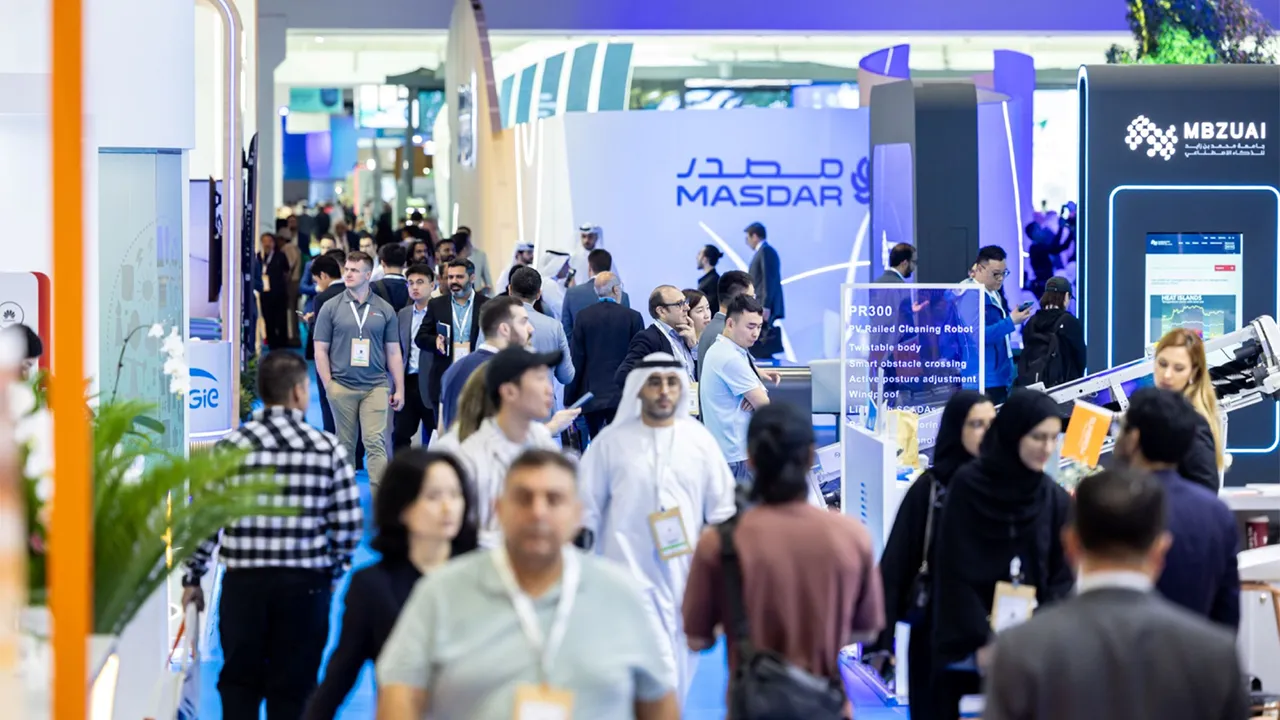
The 18th edition of the World Future Energy Summit (WFES) has delivered its most influential gathering yet, drawing more than 51,200 participants from 124 countries and reinforcing its role as one of the world’s most important platforms for energy innovation, investment and global cooperation.
Organised by RX Global, the three-day summit took place from 13 to 15 January 2026 in Abu Dhabi as part of Abu Dhabi Sustainability Week, hosted by Masdar. This year’s event brought together policymakers, energy leaders, investors and technology innovators inside the halls of the ADNEC Centre Abu Dhabi, turning the exhibition into a high-level marketplace for ideas, partnerships and large-scale energy deals.
Record international participation and global influence
The scale of the summit reached unprecedented levels. The exhibition covered 16,408 square metres across nine halls, hosting 515 exhibiting brands from 57 countries and featuring 16 specialised pavilions dedicated to sectors such as cleantech, green hydrogen, eMobility, green finance and artificial intelligence.
In addition to industry leaders and innovators, the summit welcomed 15 heads of state, highlighting the growing geopolitical importance of the energy transition.
International participation was particularly strong, with major delegations arriving from China, India, Saudi Arabia, the United Kingdom, Germany, the United States, Egypt, Jordan and Oman. According to organisers, the event’s expansion reflects its close alignment with regional government strategies, energy investment initiatives and cross-border partnerships.
$10 billion in projects and $3 billion in potential investment
Beyond the impressive attendance figures, the summit also delivered significant commercial outcomes.
Through an expanded buyer engagement programme, the event facilitated more than 3,000 meetings between exhibitors and major buyers. These discussions revolved around energy projects valued at over $10 billion, with an estimated $3 billion in investments expected to originate directly from the summit.
This growing commercial momentum confirms the summit’s evolution from a traditional exhibition into a global deal-making platform for the clean energy economy.
Innovation ecosystem: start-ups, AI and cleantech
Innovation was another central theme of the 2026 edition. The summit hosted a record 122 start-ups, many of them featured within a dedicated AI and technology hub designed to connect emerging companies with investors and policymakers.
Several innovation spaces helped accelerate these connections:
- The Greenhouse
- Green Hydrogen Innovation Hub
- Fuse AI Pavilion, which included a two-day AI conference
Together, these platforms brought over 120 early-stage companies into direct contact with global energy leaders and venture investors.
The event also hosted several co-located conferences, including:
- Carbon Forward Middle East
- EU-GCC-MENA Hydrogen & Advanced Fuels Summit
Meanwhile, the International Renewable Energy Agency (IRENA) organised its flagship Innovation Day Conference, while the Greenpeace Cinema, created with Greenpeace MENA, offered an immersive storytelling experience through film screenings and panel discussions.
UAE energy ambitions drive global attention
Discussions throughout the summit reflected the scale of the United Arab Emirates’ long-term energy ambitions.
The country has pledged $54 billion in renewable energy investments by 2030, aiming to diversify its economy and accelerate the transition to low-carbon energy systems.
Abu Dhabi remains at the centre of this transformation. The national energy company ADNOC has committed $15 billion by 2030 to decarbonisation technologies and new energy solutions.
At the same time, the emirate aims to install 10 GW of solar capacity by 2030. A flagship $6 billion Masdar-led project is already underway, designed to deliver 5.2 GW of solar power combined with 19 GWh of battery storage and provide uninterrupted clean electricity by 2027.
Collectively, these initiatives support the UAE’s broader objective of increasing its renewable energy capacity from 6 GW in 2023 to 19.8 GW by 2030.
AI and energy convergence reshaping the sector
Artificial intelligence also emerged as a key driver of the future energy landscape.
The UAE invested heavily in AI infrastructure in 2025, committing more than $148 billion to develop advanced technologies and data-driven energy systems, supported by major global investors such as Microsoft and KKR.
Within the energy sector, ADNOC has already deployed more than 30 AI systems across its operations. These technologies are helping optimise exploration, production and grid management, generating approximately $500 million in value.
At the summit’s FUSE AI Zone, more than 40 companies showcased AI solutions designed to transform energy infrastructure, optimise building design and accelerate climate-resilient technologies.
Experts highlighted how AI-powered design tools can test multiple scenarios in real time, helping engineers create buildings and infrastructure that are more energy-efficient, water-efficient and cost-effective.
Expanding global engagement
The summit’s global visibility also reached new heights. Large-scale international campaigns, combined with digital activations and outdoor promotions in major cities worldwide, significantly expanded the event’s global audience.
These efforts reinforced Abu Dhabi’s role as a global hub for sustainability dialogue and energy innovation, strengthening the emirate’s position as a convening platform for governments, investors and technology leaders.
Looking ahead to 2027
With record participation, billions in potential investments and a growing focus on AI-driven energy solutions, the World Future Energy Summit 2026 demonstrated how international collaboration can accelerate the clean energy transition.
The next edition of the summit is scheduled to return to ADNEC in Abu Dhabi from 12 to 14 January 2027, where policymakers, innovators and investors are expected to continue shaping the future of global energy systems.