
There’s a figure that should stop anyone in their tracks. In 2022, humanity produced 2.56 billion tonnes of municipal solid waste — a number the World Bank’s previous major report, published in 2018, had projected we wouldn’t reach until 2030. We got there eight years early. That alone tells you almost everything about the scale of what we’re facing.
Released in March 2026, What a Waste 3.0 is the World Bank Group’s most ambitious attempt yet to map the global waste crisis. Covering 217 countries and economies and 262 cities, it consolidates the most comprehensive publicly accessible dataset on solid waste ever assembled. The picture it paints is sobering — not just for the scale of the problem, but for what it reveals about the vast, structural inequalities in how the world handles its rubbish.
How Much Waste Are We Actually Talking About?
The short answer: far more than most people imagine, and growing fast.
Under a business-as-usual scenario — meaning we carry on more or less as we are today — global waste generation is projected to surge to 3.86 billion tonnes by 2050, a 50% increase in less than three decades. If that sounds abstract, consider that the fastest growth won’t happen in wealthy countries. It will happen in the places least equipped to deal with it.
Low-income countries are expected to see their waste volumes more than double by 2050, growing by 128%. Sub-Saharan Africa faces a projected increase of 124%, and South Asia 99%. These are regions where waste collection is already failing tens of millions of people, where open dumpsites are the norm, and where municipal budgets are stretched beyond their limits.
Meanwhile, high-income countries — which account for just 16% of the world’s population — already generate 29% of all global waste, producing 754 million tonnes per year and the highest per-capita volumes on Earth at 1.62 kilograms per person per day. North America leads all regions with 2.25 kilograms per capita daily, more than four times the rate of South Asia (0.49 kg) or Sub-Saharan Africa (0.52 kg).
Regionally, East Asia and the Pacific dominate in absolute terms, generating 33% of global waste — 849 million tonnes in 2022 — driven by the sheer scale of China’s population and industrial output. The Middle East and North Africa, by contrast, generates the least, accounting for just 6% of global totals.
What’s Actually in Our Waste?
Not all waste is created equal, and what you throw away says a great deal about how wealthy your country is.
Globally, food waste is the single largest component of municipal solid waste, making up 38.3% of the total stream. This is followed by paper and cardboard (13.9%), plastic (12.5%), garden waste (8%), glass (4.2%), and metal (3.8%).
In low-income countries, food and garden waste together account for 52% of the bin — people consume less, buy fewer packaged goods, and generate less of the engineered materials that characterise richer lifestyles. In high-income countries, the picture almost reverses: food waste drops to just 23.8%, while dry recyclables, textiles, and electronic waste together exceed 50%.
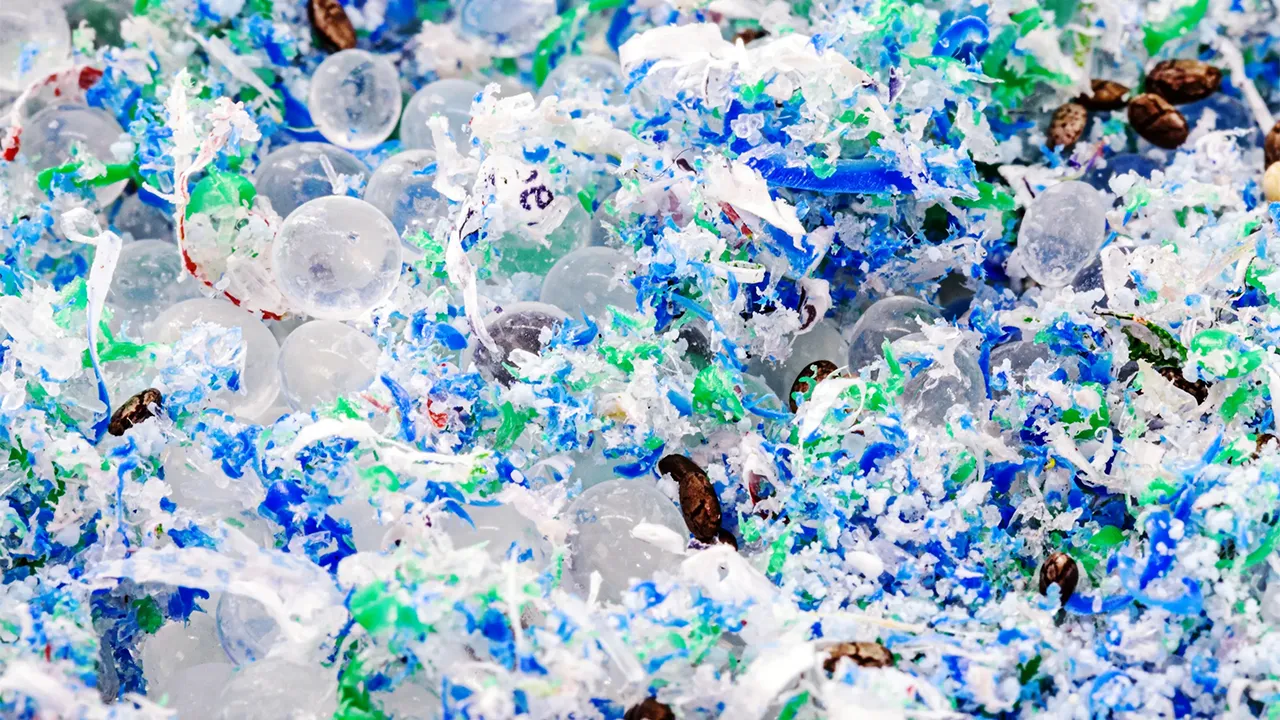
Plastics deserve particular attention. At 12.5% by weight of global MSW — ranging from 8.1% in low-income countries to 13.1% in upper-middle-income countries — plastic has become one of the defining materials of our waste stream. And 65% of all municipal plastic waste is single-use, meaning items designed for one brief interaction with a human before becoming someone else’s problem.
Collection: The First Line of Defence Is Failing
Before waste can be treated, it has to be collected. And collection is where the system is breaking down most visibly in the developing world.
In high-income countries, collection rates are effectively universal — close to 100% in North America and 99% across the high-income group as a whole. In upper-middle-income countries, the rate is still reasonable at around 89%. But drop to lower-middle-income countries and only 61% of waste is collected. In low-income countries, that figure falls to just 28% — and in rural areas of those countries, the median collection rate is a mere 5%.
Regionally, South Asia (67%) and Sub-Saharan Africa (31%) record the lowest collection rates in the world. In Sub-Saharan Africa, that means more than two-thirds of all waste generated goes uncollected entirely. It ends up burned in backyards, dumped on roadsides, or washed into rivers and eventually into the ocean.
The SDG 11.6.1 indicator tracks the proportion of waste managed in controlled facilities. High-income countries are already at 99%. Europe and Central Asia is at 92%. But low-income countries sit at just 3% — meaning almost all the waste that is actually collected still ends up in uncontrolled dumpsites with zero environmental protection.
Treatment and Disposal: A Global Patchwork of Inequality
Of all the waste generated globally in 2022, here’s where it ended up: 29% went to some form of landfill (controlled or sanitary), 21% was recycled or composted, 20% was incinerated with energy recovery, 13% was openly dumped, and 17% was never collected at all. That means nearly a third of all global waste is completely uncontrolled.
In low-income countries, the situation is extreme. Around 90% of formally collected waste is disposed of in open dumpsites that have limited or no environmental controls, and 72% of all generated waste is simply never collected in the first place. Composting and anaerobic digestion — the most sustainable ways to treat organic waste — handle just 0.04% of collected waste in low-income countries, compared with 13% in high-income settings.
Sub-Saharan Africa sends 77% of its collected waste to open dumpsites. In South Asia, that figure is 57%. These two regions, already the most under-served on the planet, are also among the fastest-growing in terms of waste volumes. The math does not add up.
In high-income countries, the approach is fundamentally different. Recycling and composting together account for nearly 40% of collected waste, supported by infrastructure, regulation, and — critically — financing. In upper-middle-income countries, incineration with energy recovery is now the single largest treatment method at around 31%, driven largely by China’s significant investment in waste-to-energy facilities over the past two decades.
Plastic Waste: A Crisis Within a Crisis
Of the estimated 400 million tonnes of plastic produced globally each year, 320 million tonnes enters the municipal solid waste stream. Of that, 93 million tonnes — or 29% — is mismanaged: 42 million tonnes ends up in uncontrolled dumpsites, and 51 million tonnes is never collected at all.
Middle-income countries are responsible for 87% of the world’s unmanaged plastic waste. In absolute terms, Sub-Saharan Africa generates 15 million tonnes of unmanaged plastic annually, South Asia 14 million tonnes, and East Asia and Pacific 12 million tonnes — together accounting for 80% of global unmanaged plastic.
In low-income countries, the numbers are particularly stark: 75% of all plastic waste generated goes unmanaged, and just 2.5% is handled in controlled facilities. High-income countries, for all their other waste challenges, keep unmanaged plastic to under 1%.
The transboundary dimension of plastic trade is also shifting fast. Global plastic waste exports fell from 12.4 million tonnes in 2017 to 6.3 million tonnes in 2022, largely because of China’s 2018 National Sword policy banning most plastic waste imports, and the 2021 Basel Convention amendments tightening international controls. From November 2026, the EU will ban plastic waste exports to non-OECD countries entirely.
Three Futures: Business as Usual, Low Ambition, High Ambition
What makes What a Waste 3.0 different from a standard data dump is its forward-looking scenario modelling. The report presents three possible trajectories for global waste management through 2050.
Under business as usual, total MSW rises to 3.86 billion tonnes by 2050, open dumping persists, and the system slowly improves but never catches up with growth in generation.
Under the low-ambition scenario, total waste reaches 3.12 billion tonnes by 2050 — still a significant increase, but achievable with moderate policy effort, including better collection, some landfill diversion, and improved composting.
Under the high-ambition scenario, global waste generation is effectively capped at 2022 levels despite ongoing population and economic growth. This requires a genuine upstream revolution: aggressive product redesign, extended producer responsibility, circular economy policies, and a global recycling rate of 54% — double what the low-ambition scenario targets.
The financial cost of ambition is perhaps counterintuitive. The low- and high-ambition scenarios actually result in lower overall global costs compared with business as usual, primarily because generating less waste costs less to manage. The exception is low- and lower-middle-income countries, where costs rise under all three scenarios — because their starting point is so far below any acceptable baseline that meaningful improvement requires substantial upfront investment regardless of how ambitious the target.
Waste and the Climate: A Methane Timebomb
The link between waste and climate change is still not sufficiently understood by the general public. It should be.
In 2022, solid waste management activities emitted an estimated 1.28 billion tonnes of CO₂ equivalent into the atmosphere. Methane is responsible for the overwhelming majority of this — 1.15 billion tonnes of CO₂e annually — generated primarily through the anaerobic decomposition of organic waste in landfills and open dumpsites. Carbon dioxide, produced mainly by incineration of plastics and synthetic textiles, contributes a further 115 million tonnes of CO₂e.
The waste sector is, according to the UNEP Global Methane Assessment, the third-largest anthropogenic source of methane globally, responsible for approximately 20% of all human-caused methane emissions. Under business as usual, waste sector GHG emissions are projected to rise to 1.84 billion tonnes of CO₂e by 2050 — a 43% increase. In lower-middle-income countries alone, emissions are expected to more than double.
The good news — and there is some — is that better waste management can meaningfully reduce these emissions. Under the low-ambition scenario, waste sector emissions fall to 1.33 billion tonnes of CO₂e by 2050. Under high ambition, they fall further to 0.91 billion tonnes — a reduction of nearly 30% from current levels. The path runs through composting, landfill gas capture, waste reduction, and getting plastics out of incinerators.
156 countries have now included the waste sector in their Nationally Determined Contributions under the Paris Agreement. But 77% of those commitments are conditional on receiving international financial support — a reminder that ambition and capacity are not the same thing.
Millions of Jobs, Millions of Invisible Workers
Waste management is not just an environmental story. It’s a labour story.
The report estimates that approximately 18 million urban waste workers are currently employed globally — roughly 0.3% of the global urban population. In high-income countries, much of this work is formal, mechanised, and regulated. In low- and middle-income countries, the picture is entirely different.
In low-income countries, 90% of waste workers operate informally — waste pickers, sorters, and collectors who are not employed by any municipality but who form the de facto backbone of recycling systems that would otherwise collapse. Globally, an estimated 40% of all waste sector workers are outside formal employment entirely, according to the ILO. These workers handle between 10 and 30% of total municipal solid waste in many countries, relieving enormous pressure on public services.
Their conditions are often appalling. Health risks, unstable incomes, no social protection, and deep social stigma are the norm. The ILO’s more conservative formal employment count puts the figure at around 6.9 million people across the sector globally, noting that employment has risen in 55 of 77 countries with available data between 2014 and 2023 — a sign that the sector is growing, but not always in the right direction.
The Financing Gap: $426 Billion by 2050 and Still Falling Short
Managing the world’s waste already costs more than US$250 billion per year. Under business as usual, that bill rises to US$426 billion annually by 2050 — a 68% increase. And yet even this enormous sum fails to capture the true cost of getting things right.
The cost of waste management varies dramatically by geography and income. Basic systems in low-income countries cost a minimum of US$40–45 per tonne. Middle-income countries spend US$70–80 per tonne for basic systems, rising to US$120 per tonne for more advanced approaches. In high-income countries, costs regularly exceed US$200 per tonne.
To achieve universal, environmentally sound waste management, the investment requirements are significant: ~0.78% of GDP for low-income countries, ~0.31–0.46% of GDP for middle-income countries, and at least ~0.33% of GDP for high-income countries. Currently, three-quarters of low- and middle-income countries spend less than 0.15% of GDP on waste management — less than half what is needed.
User fees range from as little as US$10 per household per year in low-income countries to over US$500 in high-income countries. On average, waste management absorbs 6% of municipal budgets, with cities in lower-income countries carrying a disproportionately high share of that burden.
The development finance committed to the waste sector between 2003 and 2021 amounted to just US$14.5 billion — of which only US$1 billion reached low-income countries. Against an estimated investment need of US$556 billion for low- and lower-middle-income countries through 2050 under BAU, this is barely a down payment. Carbon markets, including new opportunities under Article 6 of the Paris Agreement, offer one promising supplementary channel — the waste sector has already established a foothold through Clean Development Mechanism projects covering landfill gas capture and composting.
The Cost of Doing Nothing
Perhaps the most important number in this entire report is not about waste at all. It’s about the cost of inaction.
Available estimates suggest that the economic losses from uncollected, mismanaged waste range from 0.10% to 0.60% of GDP — and in some cases up to 1.5% — driven by health impacts, reduced property values around dumpsites, lost tourism revenue, and the foregone value of materials that could have been recovered and reused. One comprehensive assessment puts the average economic loss from uncollected waste alone at US$375 per tonne for middle-income countries in Southeast Asia — significantly more than what it would cost to collect and manage that waste properly.
Applied across all middle-income countries, the economic impact of uncollected waste corresponds to approximately 0.43% of their combined GDP in 2022. The irony is profound: it costs more to ignore the problem than to fix it.
Cleaner cities attract investment and talent. Functioning waste systems protect public health, reduce flooding from blocked drains, and prevent the contamination of water sources and agricultural land. The circular economy, where materials circulate rather than ending up in a hole in the ground or the ocean, is not an abstract ideal — it is a practical economic model that reduces input costs for industry, creates jobs across the value chain, and reduces dependence on virgin raw materials.
What Needs to Happen
What a Waste 3.0 is not a policy document. It makes no formal recommendations. But its data points unmistakably toward the interventions that actually work.
Countries need to invest in basic collection infrastructure before they can afford to think about treatment. Extended producer responsibility needs to be expanded beyond the high-income world. Deposit return schemes for beverage containers, currently rare outside wealthy nations, are among the most cost-effective tools available for reducing plastic leakage. Informal waste workers need to be integrated into formal systems rather than ignored or displaced. And the cost of doing nothing needs to be made visible — not buried in the appendix of a technical report, but presented clearly to finance ministries, mayors, and heads of state.
The three scenarios in this report offer a genuine choice. The high-ambition path is not utopian — it is technically feasible and, over the long run, cheaper than letting the crisis compound year by year. What it requires is political will, sustained financing, and the recognition that waste is not a local nuisance but a global environmental, economic, and social emergency.