

Europe’s solar revolution is hitting a paradox. While wind and solar together already supply 30% of the EU’s electricity — a milestone celebrated by energy think tank Ember — the system is now straining under the weight of its own success. The question is no longer how to generate enough green electricity, but how to deliver it reliably when it is actually needed.
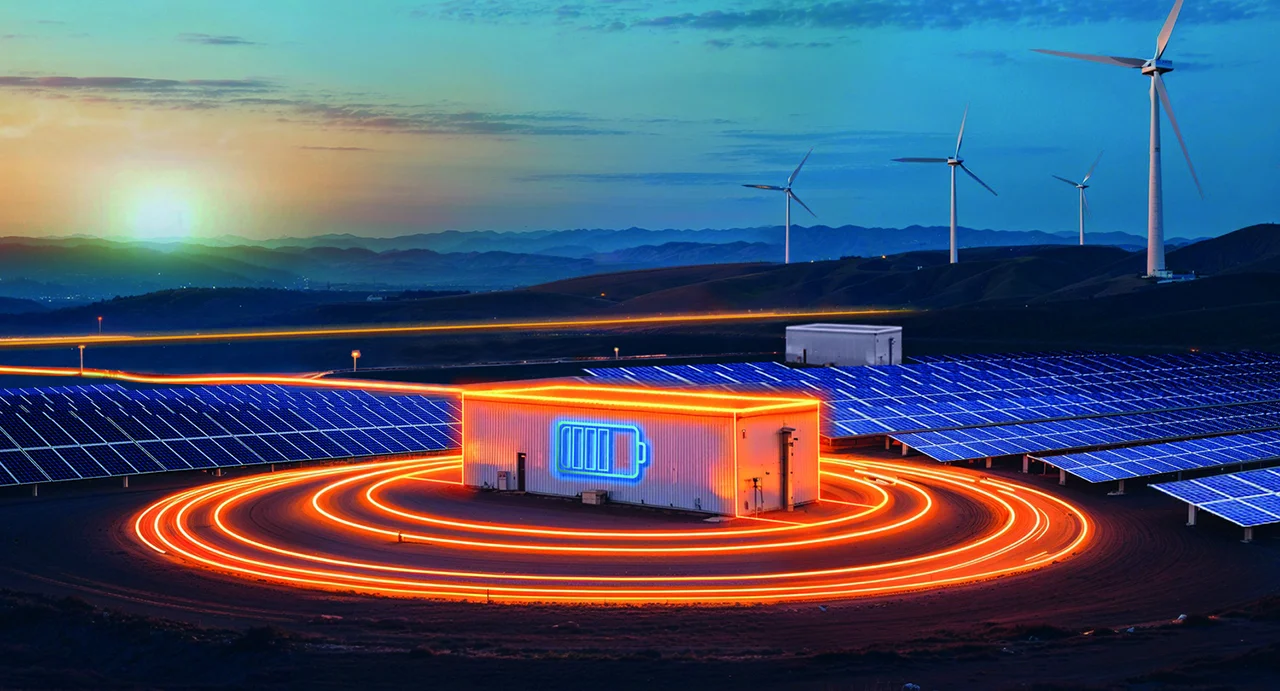
The answer, increasingly, lies in hybrid photovoltaic (PV) systems: integrated installations that combine solar generation, battery energy storage (BESS) and smart grid connectivity behind a single connection point. These systems are quickly moving from pilot projects to mainstream infrastructure across Europe.
A Grid Under Pressure
At midday in summer, large solar farms can flood the grid with more electricity than it can absorb. Prices on power exchanges crash below zero, operators are forced to curtail output, and gigawatt-hours of clean energy are simply wasted. By evening, when demand peaks again, that same electricity is nowhere to be found.
This mismatch is the central challenge of the energy transition. Battery storage resolves it by capturing surplus solar generation and releasing it precisely when the grid needs it most — smoothing out price spikes, reducing reliance on fossil-fuel backup plants, and making renewable output genuinely predictable.
The urgency is compounded by rising demand. Electrification of transport, industrial processes, heating systems and data centres — including the rapid expansion of AI infrastructure — is pushing EU electricity consumption steadily higher. SolarPower Europe, the continent’s leading solar industry association, projects EU demand will reach 3,000 terawatt hours by 2030.
€50 Billion in Annual Savings by 2030
The economic case for scaling up hybrid systems is overwhelming. According to SolarPower Europe’s study Solar+: An EU Pathway to Achieve Renewable Targets, Price Affordability, and Energy Security, quadrupling storage capacity to 171 GW by 2030 — with average storage duration rising to 3.5 hours — could halve the energy system’s operating costs within this decade.
The knock-on effects would be felt across the economy: significantly lower wholesale electricity prices, reduced price volatility for businesses and households, and sharply reduced dependence on imported gas. Solar power alone saved an estimated €8.5 billion in gas imports in just the first two months after the outbreak of the Middle East conflict. By 2030, annual savings could exceed €50 billion.
The study calls for a coordinated EU action plan aligning price signals, infrastructure investment and regulatory reform — ensuring that renewables become the competitive default across industry, transport and buildings, rather than a premium option subsidised at the margins.
From Rooftops to Car Parks: New Space, New Markets
Beyond conventional solar installations on rooftops and open land, developers are increasingly turning to sealed, underutilised surfaces — particularly car parks. The combination of EV charging infrastructure and solar-canopy systems is rapidly becoming a defining growth driver for the commercial and industrial (C&I) solar segment.
France has been a pioneer. The APER law, enacted in 2023, requires operators of outdoor car parks exceeding 1,500 m² to cover at least half the surface area with solar canopies. A 2025 amendment also permits hybrid solutions incorporating green roofing or equivalent renewable generation. Germany is following suit: numerous Länder building codes now mandate solar carports for newly built large car parks, typically above thresholds of 25 to 50 spaces depending on the region.
The rationale is straightforward: additional generation capacity without additional land consumption, combined with weather protection for vehicle fleets. For the solar industry, these regulations are opening a substantial new market across retail, logistics and corporate real estate.
Europe’s Pioneer Projects
The United Kingdom has established itself as Europe’s benchmark for hybrid PV deployment. Targeted subsidies and streamlined permitting have enabled large-scale projects to reach operation ahead of other markets. The Cleve Hill project in Kent — combining a 373 MW solar farm with a 150 MW battery system — is widely referenced as the model for utility-scale hybrid development.
Germany’s Gundelsheim energy park in the Heilbronn district goes a step further, integrating solar panels, a battery storage system and a wind farm into a single coordinated energy asset. By optimising the complementarity of wind and solar generation profiles, the project demonstrates how hybrid systems can smooth variability far more effectively than single-technology installations.
Italy is supporting similar integrated projects through dedicated incentive schemes, while Spain is reforming its auction and grid-access rules to reward flexibility. Poland, Hungary and other Central European states are also accelerating the integration of PV and storage into their national grids.
Intersolar Europe 2025: The Industry Gathers
Hybrid PV systems will take centre stage at Intersolar Europe, the world’s leading solar industry exhibition, running from 23 to 25 June 2025 at Messe München. The event — held as part of The smarter E Europe, Europe’s largest energy industry exhibition alliance, with around 2,800 exhibitors and over 100,000 trade visitors — will showcase the full technology stack: photovoltaics, battery storage, grid infrastructure, EV charging and energy management platforms.
The Intersolar Europe Conference on 22 June will host a dedicated session, Solar + Storage – Integrating Hybrid Assets for Grid Support and Flexibility, featuring real-world project presentations from developers, grid operators and flexibility providers. A further forum session, co-organised by SolarPower Europe and the Battery Storage Europe Platform on 24 June, will bring together leading industry voices to discuss the fast-evolving role of hybrid systems across Europe.
As the energy transition accelerates, hybrid PV systems are shifting from an innovative niche to the structural backbone of a resilient, affordable and carbon-free European electricity system. The technology is ready. The economics are compelling. What remains is the policy alignment to unlock it at scale.