

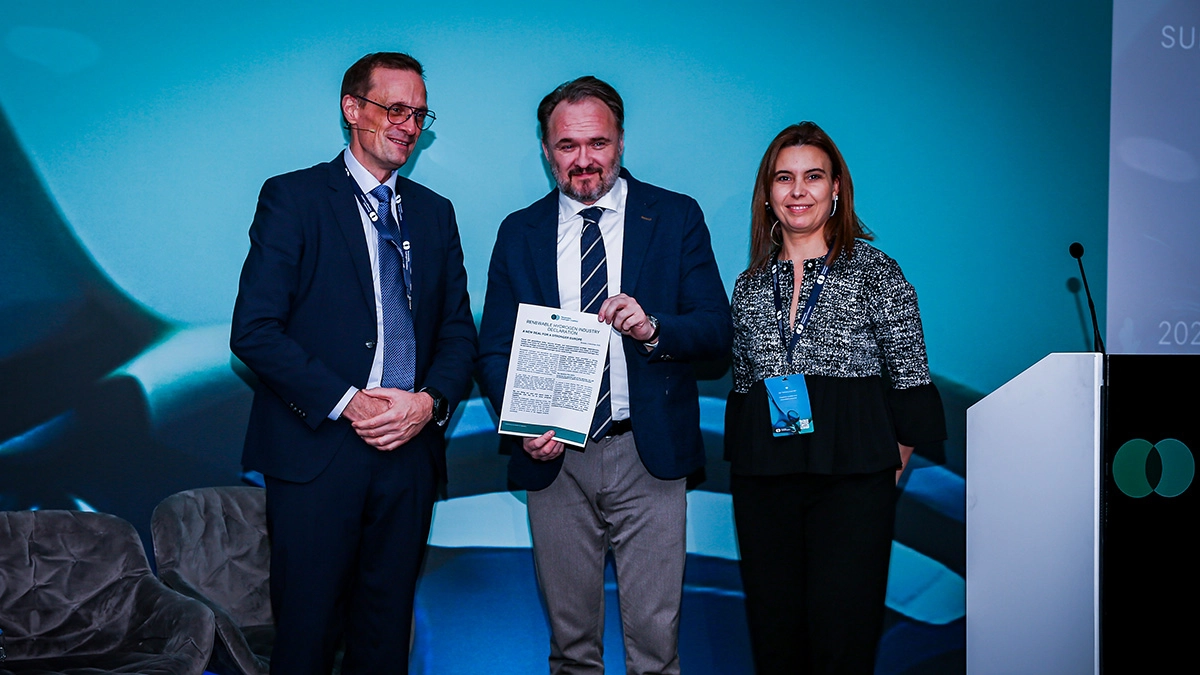
A New Call to Reinforce Europe’s Hydrogen Leadership
During the Renewable Hydrogen Summit held in Brussels on 4 December 2025, Commissioner for Energy and Housing Dan Jørgensen renewed the European Commission’s commitment to a rapid scale-up of renewable hydrogen. The Renewable Hydrogen Coalition (RHC) issued a clear appeal for a New Deal to maintain Europe’s first-mover advantage in a context of intensifying global competition.
Renewable Hydrogen as a Pillar of European Resilience
Building on a Summit Declaration, industry leaders emphasised that renewable hydrogen plays a strategic role in strengthening Europe’s resilience, decarbonising sectors that cannot easily be electrified, and supporting the rise of clean-technology industries capable of generating high-quality European jobs.
Rapid Growth, but Business Viability Remains Out of Reach
The sector has expanded at remarkable speed. Electrolyser manufacturing capacity has grown from 1 GW to 10 GW, with projections that it will reach 15 GW by 2026. Meanwhile, production projects are scaling in size across multiple EU countries. However, industry leaders caution that viable business models and firm demand are still missing, underscoring the need for stronger and more targeted policy support.
Industry Voices: From Ambition to Tangible Results
Ana Quelhas, RHC Co-Chair and Chief Hydrogen and Data Center Officer at EDP Renewables, stressed that ambition alone will not deliver Europe’s hydrogen ambitions. She called for support frameworks that catalyse demand, reward scalable and investment-ready projects, and reflect the real cost gap through flexible and cumulative funding schemes.
Topsoe’s Power-to-X CEO and RHC Co-Chair, Kim Hedegaard, added that innovation leadership does not guarantee manufacturing leadership. For Europe to scale commercially, EU-made clean technologies must be prioritised in funding calls, with non-price criteria such as sustainability, resilience, and local content integrated into support mechanisms.
Policy Priorities Identified in the Summit Declaration
The Declaration released at the Summit calls for policymakers to adopt urgent measures to stimulate demand for renewable hydrogen products, secure supply, build the necessary electricity and hydrogen infrastructure, and ensure that public funding aligns with the EU’s long-term industrial and climate objectives.
€3 Billion Hydrogen Bank Round Announced
The European Commission announced the launch of the third auction of the European Hydrogen Bank, funded by €1.3 billion of EU resources. This is complemented by national contributions: Spain with €415 million and Germany with an additional €1.3 billion. Together, these commitments increase the available funding to over €3 billion, highlighting the growing importance of the Hydrogen Bank for domestic projects.
The RHC encouraged additional Member States to join this effort to ensure a unified and strengthened European push.
A Sector United Against Rollbacks and Policy Weakening
Against the backdrop of attempts to weaken EU climate and energy rules, RHC leaders urged like-minded organisations to join the Coalition and advocate for policies that accelerate renewable hydrogen growth. Industry actors reaffirmed their commitment to accelerating investments and delivering mature, large-scale projects, provided that Europe implements robust policies reflecting hydrogen’s strategic relevance for industry, climate action, and energy security.
Europe’s renewable hydrogen sector stands at a decisive moment. With rapid advancements and rising global competition, only a comprehensive New Deal can secure the EU’s leadership in clean hydrogen technologies, reinforce its industrial resilience, and accelerate the path to climate neutrality.